Tag Archives: memoir

540. Where Are the Vets?

Here are some statistics, tailored for those who read this blog. I know most of you are young. I see your pictures on your likes, and I check out your websites.  I’m not young, so I see changes you may not be aware of.

Harry Truman, Dwight Eisenhower, John Kennedy, Lyndon Johnson, Richard Nixon, Gerald Ford, Jimmy Carter, Ronald Reagan, and both presidents Bush all served in the military in wartime. Regan and Bush Two served stateside in wartime; the others all saw combat.

Bill Clinton, Barack Obama, and Donald Trump did not serve.

In the current House of Representatives only 70 of 435 have served in the military. In the current Senate, only 13 of 100 have served. Those numbers will go up slightly with the incoming congress.

Veterans were not so under represented in previous congresses.

These figures relate the the reduced number of persons in the military. That is not quite the same as a smaller military, since the persons now serving tend to spend more years in service. Draftees from previous eras tended to go home as soon as they were allowed to do so.

I come from a long line of draftees. My father served in Europe in WW II, was wounded, and remained during the occupation of Germany. His younger brother was drafted, trained, and was on a ship “heading for Japan to die” (his words) when the US dropped the A bomb. He ended up in the occupation of Japan. I joined the Navy, Vietnam era, but not by choice. My draft number was 41, which meant my number was up (in both senses of the word) before I finished college. And no, I did not see combat.

I hated the draft and I still do, but it had one positive aspect. It leveled the playing field. More Americans had to step up, whether they wanted to or not, and that led to more protests. Without the draft, we would have been in Vietnam much longer.

Today is the hundredth anniversary of the end of WW I. All those veterans are gone. WW II ended in 1945. Very few of the vets from my father’s generation are still around.

America left Vietnam in 1973. Any vet who saw that day at age 18 would be 63 today. That was also the last  year American’s were drafted.

I’m not suggesting a return to the draft, God forbid. I have no particular agenda at all; I just want to give you this to think about.

A country which everyone has to defend, or at least has to stand in jeopardy of military service, is a very different thing from a country that depends on a volunteer military.

Better? Worse? That will be your decision going forward.

======

The numbers in this post come from PBS.

538. Not Like Clockwork at All

I have been writing my latest novel Like Clockwork for ten months and today (October 17) I called it “first draft done”. But it’s not that simple.

I have a file on my computer called ???When???, where I keep track of starts and finishes because I would never remember dates otherwise. I went there to make note of the tentative conclusion of the first draft and took time to remind myself how I got here.

It’s a tangle. I’ve had books that took longer to write, and books that grew well beyond the size I had intended, but I have never before had a book that refused to tell me ahead of time what was going on. I decided to share the file of my progress(?), edited to remove irrelevant family matters.

===============

January 2, 2018. I began the first page of a novel/novella with the working title Clockwork Christmas.

Jan. 13, 2018.  Clockwork Christmas is now titled Like Clockwork, after the toy store where Snap works. As of today, I am about 12,000 words into the thing. I hope it will reach at least 60,000 words to be sold as a novel, but it still could possibly be finished at novella length.

(For reference, SFWA sets novella length at 17,500-40,000 words. F&SF sets 25,000 as the largest piece they will publish.)

Like Clockwork is being constructed of (minimum and approximate) 1000 word chapters.

From roughly 17 to 22 January, 2018, I paused Like Clockwork to write posts for the website. (There were several pauses for colds and other minor illnesses which I will not record.)

On Jan 31, I wrote chapter 10 in which Balfour gets the idea for Jekyll and Hyde. He does not yet know that he already wrote it in another life.

Mar. 6, 2018, things are coming slowly. As of today, about 25 chapters done. That’s a large number, but each chapter is short.

March 11, 2018  Today Stevenson emerged into consciousness, absorbing both Balfour and Hyde. That lasted about a day, then Balfour realized he can’t be the actual Stevenson because he remembers Stevenson’s tombstone. What exactly  is he? As of now, I have no more idea than he does.

April 3, 2018, writing on the chapter Slow Time, I began to show Bartleby’s dogged determination to follow any task to its completion. The question occurred to me for the first time, is Bartleby human, or a robot or android. As of this date, I hadn’t decided if he is a person or an living story character with Melville as Fabulist, and now here is a third possibility.

April 4, 2018, writing the final paragraph of the chapter Slow Time I came to the realization that Like Clockwork is the story of a whole cadre of people who made a Faustian bargain, got what they asked for, and now are suffering from buyers’ remorse. I also came to the realization that yesterday’s question, “Is he a robot?” is answered this way — he is a cold, detached, hard boiled detective type who can’t be pushed aside from a goal or puzzle. He doesn’t need a personality any more than Sam Spade did. Not a machine, but thinks like one.

(Aside — Bartleby’s name changed as the writing progressed. First he was named after the Melville scrivener. Then he became Helmsman. I liked that name but it implied that he was a leader type, which he wasn’t. Finally he became Hemmings, because it’s just a name with no hidden meanings.)

About here, some time was devoted to my personal life, plus the completion of an unrelated short story.

On about June 28, I became aware the Tor would accept novellas beginning July 30. Like Clockwork had been nearing its end at about 70000 words. That doesn’t work for today’s publishing industry, and some of that was less that compelling writing in a long flashback section. I had three choices. Shorten and go for Tor novella publication, stretch even further and try to reach salable novel length, or let it find it’s own length and self-publish. I have opted to make it a Tor novella, although the other choices remain if Tor rejects it.

On July 14, 2018, I finished the Tor novella version of Like Clockwork, now retitled The Clock that Ate Time. I still have to do some e-formating to match their submission engine. The novella version runs 39,365 words. I had to cut out everything relating to Hemmings and Crump, which means cutting out the Babbage and Hemmings’s brief career as a sweeper in a factory, along with the extended memory-retrieved-as-flashback that details how the Founder set up the whole thing and why. I really hated to let go of all that.

I would enjoy the long version better, but the short version is less discursive. If the novella doesn’t fly, I may try it elsewhere (if there is any elsewhere — F&SF maxes out their novellas at 25,000 words) or I may go back and finish the long version. For now, I’m just glad to be at least temporarily done with it.

The novella version went off to tor.com.

You have to understand that writing is schizophrenic. I was sure that it would be accepted. No other outlook would allow a writer to retain his sanity. I was equally sure that it wouldn’t be accepted. The market being what it is, everyone on Earth with a novella ready is going to jump into the tor.com window of opportunity.

From the end of July until the beginning of October, I worked on other projects.

Oct 2, 2018   tor.com rejected The Clock that Ate Time, resulting in disappointment followed by relief. Now I can complete the novel version. Bear in mind, it is not insanity to carefully edit out feelings of irritation and disappointment, as long as you know that you are doing it.

Now I am expanding Hemmings part of the story and grafting it back onto the whole. It is called Like Clockwork again and it is taking forever to complete.

October 17, 2018 I finished both part one and part three of Like Clockwork months ago. I have recently been filling in the middle third, which amounts to a long flashback that explains how reiterant London came to be. Today I wrote the last line of the middle section. I still have several  half-page long dialogs or descriptions to fill in, and I still haven’t quite finished deciding how to integrate Hemmings and Crump into the big finale, but I am calling it “rough draft finished”.

Still, it feels (and is) very unfinished at this stage. I think I need to fill in more of the Founder’s personality. That may take only a few touches here and there, but they have to be the exact right touches, and that can take a long time. I also have four versions to integrate: beginning, middle, and end of the latest version, along with the tor.com version which is the least extensive but most polished.

I need to find something to write next, or perhaps finally decide to begin self-publishing; it may take a long time for all the finalizing of Like Clockwork, a few hours here and a few hours there.

===============

See what I mean? This is my fourteenth book, and the only one that has driven me this crazy. I know that I did a lot of character name dropping, but that was unavoidable. I don’t expect you to understand anything except the level of madness this book has engendered.

Today I started deciding which potential novel will be number number fifteen. I plan to outline this one.

I think.

534. A Writer Lives for Libraries (3)

Just before I entered high school, the shrinking population of our county caused two school districts to consolidate. They built a new high school and bussed students in from miles away. One room of that new high school was full of empty shelves with boxes of new books sitting on the floor. Since I already knew the English teacher/librarian, and since I was a hard worker (and he wasn’t) I got to empty those boxes and fill those shelves. There is no better way to learn a library than from the ground up.

There were piles of books on science, and I read most of them. There was a copy of Heinlein’s Stranger in a Strange Land which had just been published. It would have been banned if any of the Baptists had gotten hold of it, but I was probably the only one to read it. That was the book in which Heinlein made sex seem dull. They can’t all be winners.

I graduated from high school, went to college, got married, went into the Navy, and returned to graduate school at the University of Chicago, where I got to use the Regenstein Library. Then I started writing. Wherever we went, my wife got a job at the local library — often in the bookmobile.

I has some success writing but not enough to live on, so I got a credential and made teaching middle school my day job. I kept that day job for twenty-seven years, still writing but with much diminished output. Then I retired and I went back to writing full time.

Once, during that period, the school where I was teaching had a special day in celebration of reading. My teacher friend Crystal invited several of us to talk to her class about our early reading habits.

I went to the local library and found an original copy of Star Man’s Son still on the shelf. It wasn’t the same copy — I was fifteen hundred miles from the library where I started out — but it was the same edition. It probably came off the same press the same week.

Thank God for libraries that never throw anything away. When my turn came, I was able to hold it up and say, “Here is the first book I ever checked out.” Then I could hold up copies of Jandrax and A Fond Farewell to Dying and say, “And here are the books I’ve written, because long ago I learned to love to read.”

Now I live in the foothills of the Sierras and, coincidentally enough, I am once again equidistant from three cities. Each one is a county seat, and each one has a library.

One is the city where I lived for all my teaching years. Its library is in a newer and larger building now, and the books are reasonably up to date. I go there often.

One of the other libraries is old and poor. They have lots of books, but some of them are older than I am. They have a full selection of Buchans, mostly in identical bindings from some original matched set. They have a matched set of Jules Verne, as well, and both sets are battered and worn. As I walk up and down the shelves, I see lots of books that I saw in my first library fifty years ago.

I’m glad to have a library where everything is up to date, but it is also nice to have a place where I can step back into the past, to pick up copies of those books I didn’t have time to read when I first encountered them. Not every good book was written this decade.

Now turn off the computer and go check out a book.

533. A Writer Lives for Libraries (2)

Readers today are contemptuous of Tom Swift and his kind, and with good reason. I had loved those books up to my first day in the library because they were all I had. They had filled lots of hours with lots of entertainment, and had opened me up to worlds beyond the farm.

Once I had access to libraries, I took home real books, mostly science fiction, and things would never be the same. With my first book, I met a real writer; Andre Norton had something to say, and she said it with grace and style. Ultimately, I would find Heinlein, Zelazny, Dickson, Le Guin, and hundreds of others beyond science fiction. But Norton was the first and she taught me how to write. Almost sixty years later I still hear the echo of her style in my writing.

In full disclosure, the county library I’m talking about was not quite my first library. My class in grade school – all eight of us – were the last to haunt a building that had housed three hundred students before my town shrank. We discovered a disused closet that still held the books that had once been the library, and there I read my first book for adults, Thomas Costain’s The Black Rose.

The county library in Claremore was where my heart and soul lived, but I also had a dalliance with the library in Collinsville. It was an old, small, red brick building donated by Andrew Carnegie. If you have passed through small town America, you’ve probably seen one just like it. Carnegie libraries all look the same.

That was where I discovered one of the great secrets of life: libraries are time machines. I don’t mean that they have books on history. I mean that they never have enough money, so they never throw anything away. In Collinsville in the sixties, the shelves were full of books published during and before World War II. Not only were they about bygone days, the books themselves were actually, physically old. Hundreds of boys, too young to fight, had sat in that library reading the Dave Dawson war books that I now held in my hands twenty years later.

The same actual books. Match that, ebooks!

So I learned to re-read, and to treasure books from eras past. I still read John Buchan regularly, holding my nose at his imperialism and racism.

While digging through the books at home, I found one rare treasure, Tom Swift and his Electric Rifle, published in 1911. Yes, the taser book, although I couldn’t know that because this was long before tasers were invented.

My grandfather, who lived in Florida and whom I saw only once a year, had read this Tom Swift (Sr.) book fifty years earlier, and he was the one who sent me my first Tom Swift Jr. many years later. Wow!

Libraries are great, but everybody needs to have a stack of books of his own. more on Monday

532. A Writer Lives for Libraries (1)

A bit of this was published in very early posts, but it has been completely rewritten.

A writer lives for libraries.

If you want to be a surgeon, there are a hundred textbooks you will have to read. If you want to be a lawyer, the reading list is even longer. If you want to be a novelist, however, you don’t read textbooks, or how-to books. Oh, you can, but beyond the basics, they are worthless.

If you want to be a writer, you have to read whole libraries.

Of course, for a minimal amount of money, you can live on e-books, and know everything about what people think in 2018. If you want a broader education — if you want to know what people were talking about in 1988, or 1908, or 1758, you need libraries.

(The primary exception to this rule is Project Gutenberg, which I recommend without reservations. Check out this, and this, and especially this.)

I didn’t have access to libraries when I grew up. I was born on a faraway planet called Oklahoma in the fifties, on a farm three miles outside the nearest town, and that town was tiny. We had no plumbing at first and the wind blew through the walls in the winter. Don’t get me wrong; I loved life on the farm, and it wasn’t poverty. This was normal life at the edge of the world on the edge of the modern era.

I learned to read from Little Golden Books. They were cheap, available at the local dry goods store (local means twenty miles away), and Dr Seuss wasn’t writing yet. When I was about ten, my grandfather sent me a copy of Tom Swift Jr. and his Outpost in  Space for my birthday. I was instantly hooked.

We lived midway between three towns, which we visited frequently. If you farmed in the fifties, you spent half your time farming and half your time fixing broken machinery. That takes replacement parts, and that means a trip to the John Deere dealer.

Every time we went to town, my great-grandfather would give me a quarter. Tom Swift Jr., the Hardy Boys mysteries, and Rick Brant adventure books all cost a dollar each. I bought a book every fourth trip. Looking back, most of these books were terrible, but a few were gems.

When I was about twelve my mother dropped my father off to buy parts, then drove to the other end of town and took me into the county library. I had never seen a library and was barely aware that they existed. I almost fell out of my work boots. It was a big room with tables down one side, and ten double shelves of books down the other.

“Library, where have you been all my life?”

The nice lady librarian typed up a temporary library card and told me I could only have one book the first time. She would be a big part of my life until I left for college and I still remember her face, but I never knew her name.

My mother was waiting, so I quickly picked up a book. It was Andre Norton’s Star Man’s Son, and my fate was sealed. more on Wednesday

531. I Knew!

I suppose there are writers who finish a first draft and move on to the next book. Louis L’amour was like that; you can tell from his goofs. There will be a statement in chapter three that is flatly contradicted by another statement a few chapters later. It’s the kind of thing that even a cursory second reading would have caught.

For the rest of us, there are always bits left on the cutting room floor. In my case, whole novels worth, but I’m probably extreme.

One thing I like about computers is that when inspiration strikes, you can write down an unrelated paragraph or two right in the middle of the chapter you are working on, and then go back to what you were doing before. Maybe put it in bold to catch the eye. Later, at leisure, you can retrieve it. I do that all the time, and with every rereading the bit catches my eye and reminds me to make room for it.

Sometimes, no matter how good a bit is, it never gets used. That offends the little voice in my head that says waste not, but there is no help for it.

I was revising Like Clockwork today when one of those bits shamed me that I couldn’t find a place to use it. For context, one of my characters, called Balfour, is a kind of ghost of Robert Louis Stevenson. In the bit that will never be used, someone says to Balfour . . .

“You wrote a boy’s book about pirates. Who knew that there was anything more than that in you?”

. . .  and Balfour replies . . .

“I knew.”

Anyone who writes genre fiction will understand Balfour’s pique at the assumption that he was only a writer of books for children.

528. Repeat, with Variations

You hear it said — author Joe Doakes has written the same book thirty times. The phrase is sometimes supercilious and often has more than a touch of envy hidden in it. The implication is, “Hell, I could do that.”

True confession: I couldn’t. Sometimes I feel good about that, and sometimes I wish I could do that, because repetition is one of the main paths to $ucce$$. I keep telling myself it is not the only path.

If you are, or want to be, a writer, you should examine this notion from the viewpoint of a reader, standing in front of a shelf of books, with only enough money and time to buy and read one of them.

The one with the naked woman catches your eye (male viewpoint assumed; for alternate gender, insert your own preference) but you’ve been burned by that advertising gimmick before. One looks likely, but you’ve never read anything by that author before, so you hesitate. If you could find a book by a favorite author, you would be reassured. If you could find a book by your favorite author, featuring a favorite character, your satisfaction would be almost certain.

It’s that simple. In addition, the author has the advantage of not having to invent a new main character for each book. It might be that finding something new for an old character to do would become tedious, but I can’t report on that from personal experience. No wonder publishers want books that can become the first of a new series.

We are talking about comfort food books here; true escapist reading for the times when you want to think, but only just a little. Television substitutes. Something for the long-haul trucker to read at night to take his mind off the fact that his wife is two thousand miles away, and what he would really like to be doing is . . .; you get the picture.

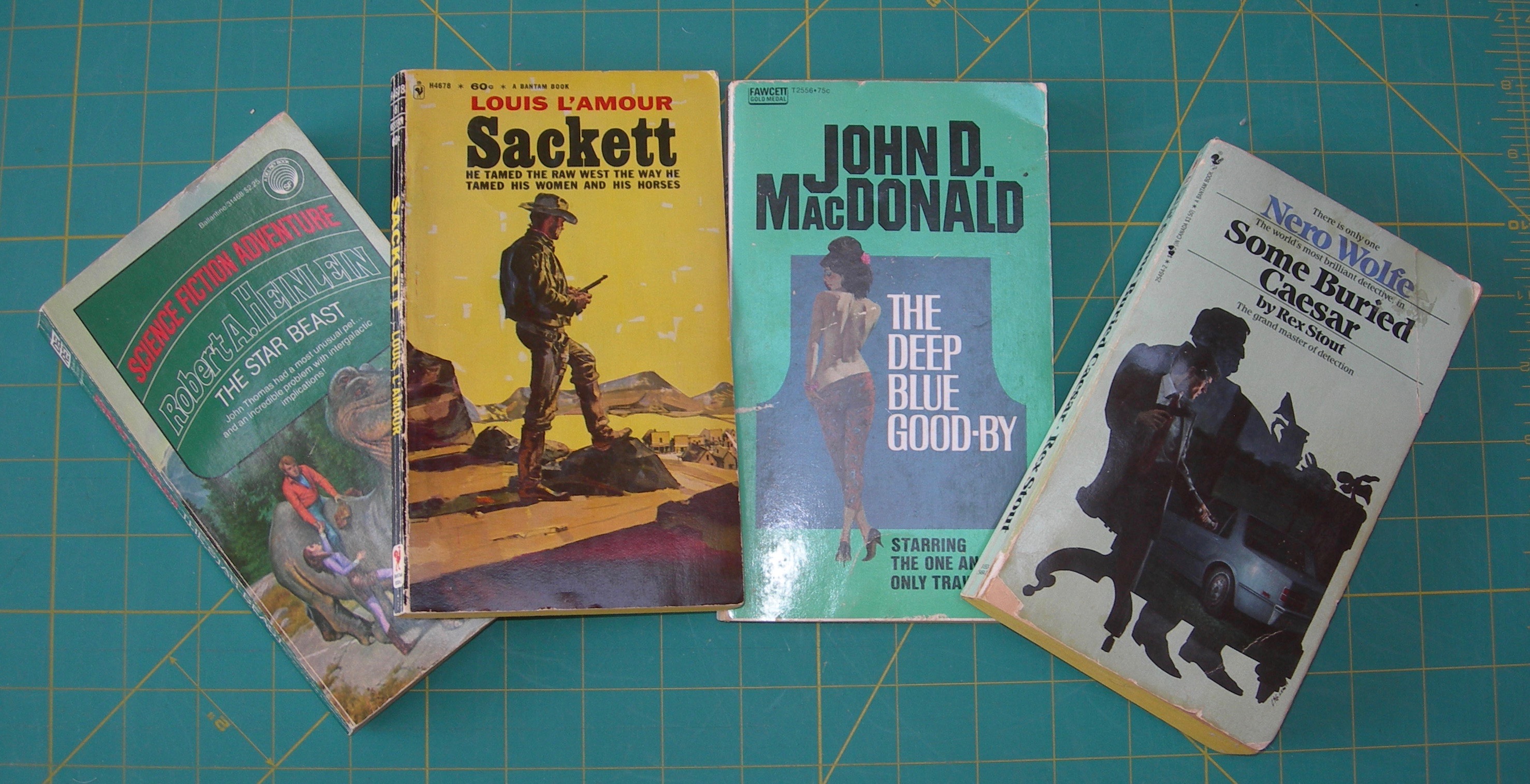
For me, during my first twenty years of writing, my go-to escape was Louis L’amour. I was writing science fiction and fantasy; he was writing westerns. He didn’t exactly write the same book fifty times. If he had, I couldn’t tell his good ones from his bad ones, and he had both. (Read Flint or Conagher, but avoid The Haunted Mesa.)

After beating my head against the typewriter (this was pre-computer) for a few hours, I would pick up a Louis L’amour western and ride off across the plains. Thoughts of interstellar travel were banished until the imagination well refilled itself. It was good stuff, but I don’t read him much any more. I have them all memorized.

I also have Heinlein in the photo at the top, which is a little unfair. He was not guilty of writing the same novel over and over (people who have only read from the second half of his career may disagree), but he only had one character. Male, female, both alternating, old, young — it didn’t matter. Every one was the Heinlein character, so if you liked one of his books, you were likely to like the rest. And if not, not.

The Travis McGee books are a clinic in how to do a series character who can continue to repeat with variations. No one ever did branding as well as John D. MacDonald. Every book contained a color in the title. He wrote The Deep Blue Good-by, Nightmare in Pink, A Purple Place for Dying, the Quick Red Fox, and seventeen more shades. You could recognize a McGee book from across the bookstore. MacDonald’s biography was titled The Red Hot Typewriter. In it, he explained that before he committed to the series, he wrote the first two novels to see if he could stand to be married to McGee for decades. For more, see 49. The Green Ripper.

The Spencer novels belong here as well. I read with pleasure through the first ten or so; each one was reasonably unique and expanded his character. The next thirty were increasingly dreary repetitions; they provided a quick escape and as quickly faded from memory. I still occasionally re-read one of the early novels, but the rest were all one-and-done.

Today, when the writing stalls, I rinse my mind out with Nero Wolfe and Archie Goodwin. I can’t say I really like them, but I always know what to expect.

524. The Other Side of Dying

Atheism is not a satisfactory solution to life. It may be the truth — I’ve thought so for fifty-five years — but it isn’t satisfactory on many levels.

Religion, and it doesn’t much matter which one, is quite satisfactory, as long as belief holds out. The problem of death is solved by not dying, not really, just moving on to the next step in an ongoing life. I really miss the comforts of that belief. The question “why are we here?” is not really solved, but it gets kicked upstairs to the fellah at the higher pay grade, so we can stop worrying about it. Good enough; now we can get on with life.

Cyan, which is out now, is one of those novels that never gets into religion. There are thousands of them out there. However I grew up as a fundamentalist Christian, then changed my mind. That means religion plays a big role in my thinking and, therefore, in most of my writing.

My first science fiction book, Jandrax, concerns a group of fundamentalists stranded on an unexplored world. The hero is an ex-fundamentalist. Sound familiar?

My next SF novel, A Fond Farewell to Dying, concerned an ex-fundamentalist who had invented a mechanical form of immortality. Wish fulfillment, maybe? FFTD was designed to present a completely mechanistic world view, but about half way through the writing, unexplained things started happening in the manuscript. Events occurred that the hero’s version of immortality could not explain. Don’t blame me; they weren’t my (conscious) ideas, but clearly something in the back of my head was yelling “this isn’t enough.”

I left all the oddities in place. It is unwise to ignore the gods, or fates, or subconscious, but all my characters ended the book more or less happy with the result of their eternal lives.

My latest novel, Like Clockwork, takes place in a world where everybody lives forever, and nobody is satisfied. These are a group of people who were self-chosen for their disbelief, and given an alternative to death. They accepted, but have ended up with a massive case of buyer’s remorse.

I can’t tell you more, without giving away the plot, but their version of immortality is pretty screwy. I’m consciously bringing things full circle, with a work that is a deliberate flip side to A Fond Farewell to Dying.

There are two — or more — sides to every story. Fortunately, as writers we don’t have to know the philosophical truth of the universe. We just have to tell a plausible tale that resembles reality enough to please our readers. And if we get to exorcise a few personal demons at the same time, it’s a nice bonus.

Short note, bad joke

I am working on a story which includes a person whose father was protestant and whose mother was catholic. As a result, the character is ambivalent about religion. He says at one point, “I prayed to a Protestant God when my father was listening, and to a Catholic God when my mother was listening. It was all the same to me.”

In another place, this sentence occurs —


His bi-sect-ual childhood had made him immune to religious enthusiasm.

I took the offending adjective out today. It was just too jarring to leave in place in a serious work. But oh how the smart-ass in me hated to see it go — so much that I had to write this mini-post before it faded into the ether.

It won’t be in the final manuscript, but at least you heard it here.

516. 15 Best Stories

I’ve been reading people’s lists of favorites just about as long as I can remember. It’s a great game — pitting their best list against my best list. They always lose.

So I decided to make my own best 100 list, but it didn’t work. I stalled at sixteen. Then I looked again at some of those favorites that I hadn’t read for a while, and the number dropped to fourteen. Then I remembered another long un-read classic and the number went up to fifteen.

The small number is partly because I am picky, and partly because I can’t remember every book I’ve ever read. Nevertheless, the ones I remember deserve a shout-out, and I guarantee they are an eclectic group. They do have one unifying characteristic — they all sing.

That they sing is the only real criterion for greatness in my universe. This means finding the precise balance between workaday language and the kind of overblown language that is too precious to live. That point of balance depends in part on the story being told. Hemingway, Roberts, and Le Guin, three authors from the list, are quite different from one another but each strikes the precisely right note for the story he or she is telling.

Here is the list. Six of the entries have been covered already in previous posts. I have keyed most of them with a link at the bottom of this post so you can check them out. The remaining nine will show up as individual posts over the next couple of months.

These are a mixture of novels, novellas, compilations of linked short stories, and series of novels. Some are the best or most accessible books that stand for a writers whole body of work. One represents a brilliant writer whose career was cut short before he wrote a single SF or fantasy novel.

Works that hit the sweet spot.

Nine I haven’t yet written about.

The Old Man and the Sea               Ernest Hemingway
Pavane                                               Keith Roberts
A Wizard of Earthsea                       Ursula LeGuin
The Road to Corlay                          Richard Cowper
Lensman Series                                E. E. Smith
Jack of Shadows                               Roger Zelazny
Davy and
The Trial of Calista Blake               Edgar Pangborn
The Traveler in Black                      John Brunner
Highland Laddie Gone                   Sharyn McCrumb

Six I have written about

Hunter, Come Home                     Richard McKenna
Richard McKenna had one novel in his short career, The Sand Pebbles, a best seller but not science fiction. He also wrote a number of short science fiction pieces including this one.

A Prince of the Captivity               John Buchan
John Buchan is most famous for his novel The 39 Steps. My selection is a less well known work.

The Riddle of the Sands               Erskine Childers
Erskine Childers wrote this, the first modern spy novel.

Kidnapped/Catriona                    Robert Louis Stevenson
There are two posts on this, 508 and 509, both just last month.

A Christmas Carol, et al              Charles Dickens
Altogether, Charles Dickens wrote five Christmas novels.

The Three Stages of …                Robert A. Heinlein
No link here. Check Wednesday’s post.