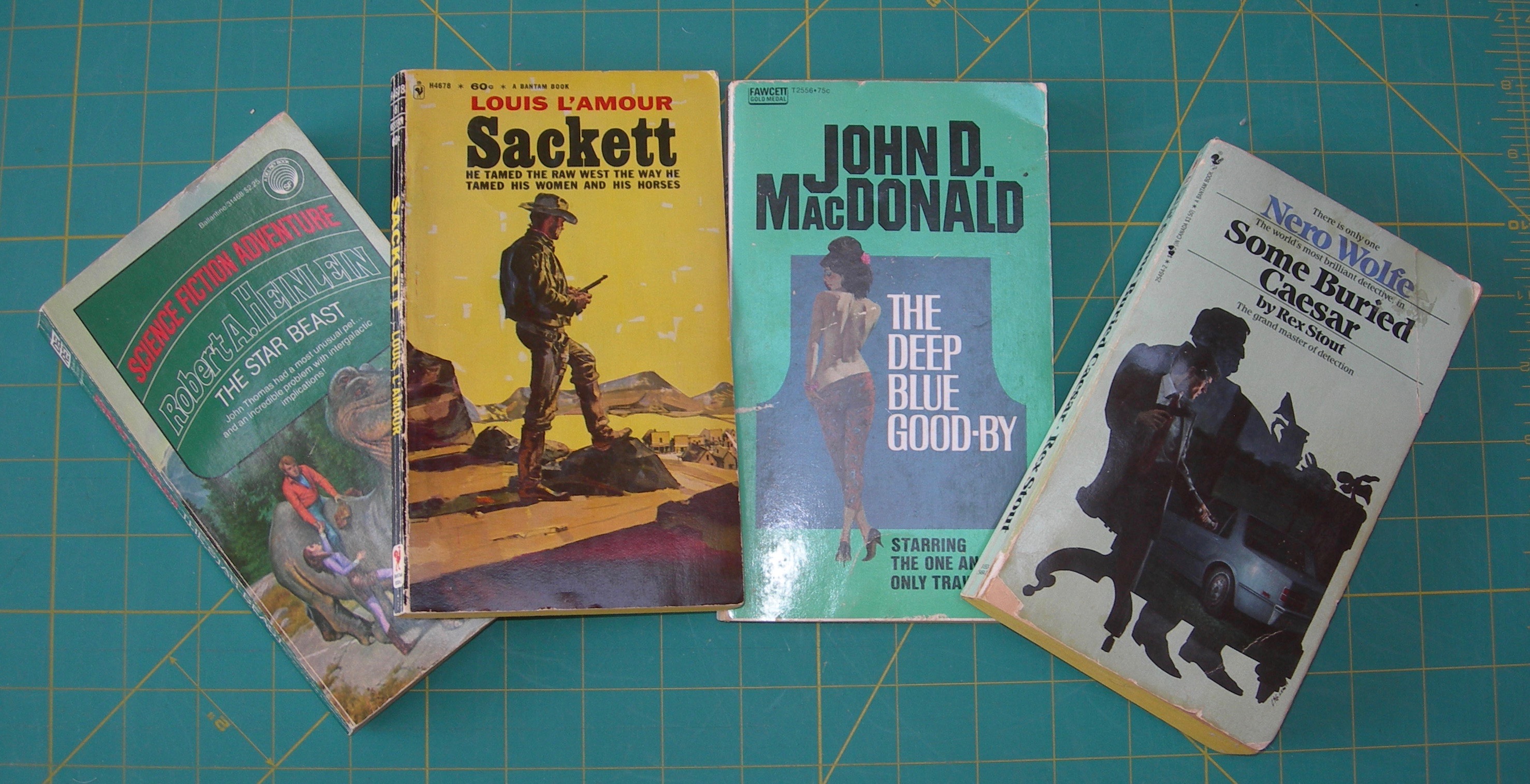
 Jandrax was the second novel I wrote, and the first that was published, back in the late seventies. You can still find it in used bookstores everywhere. If you were to read it, you would never know that I wrote it twice.
The first time through, I wrote it in first person. It didn’t work for me. I agonized a bit about what was wrong, then bit the bullet and rewrote it from start to finish in third person.
By the way, this was before computers . No cut and paste, no spell check. Just an electric typewriter and gallons of correction fluid — that thin white paint that came in a small bottle with built in brush, and was a lifesaver for poor typists.
Also, I cheated. Two chapters sounded just fine in first person, so I left them that way. One is a main character reminiscing about his childhood, and the other is another main character, alone in a boat, talking to himself as he undergoes experiences that may or may not be real.
I have written fifteen novels, and only that lost iteration of Jandrax was in first person. I could give you good plot-based reasons for that, but the reality is that I like the distance third person put between the author and the work. That may be a mistake.
Recently, I have been analyzing what makes books readable and re-readable, and that has led me to my favorite SF writers, Heinlein and Zelazny. For all their differences, they share a few authorial traits, including the fact that both are masters of first person.
Each author has a stock character that recurs with variations. For Heinlein, it is complicated by the fact that his stock character often comes as a matched pair. There is an older, seasoned man of the world, cynical, with no apparent respect for authority. He will, nevertheless, hurl himself into danger for his own people while pretending that he is doing it for selfish reasons. He reads like your crazy uncle. The matching character is a young smart-ass in training, studying up to become like the oldster. But don’t accuse him of that. He would punch you in the nose if you did. Or at least, threaten to.
Zelazny didn’t limit himself to one stock character, but he did have one that recurred frequently. He was part way between the halves of the paired Heinlein character. He was young, but fully formed. He had the attitude of a smart-ass college student, an upper class-man who had already learned the ropes. The kind who knew which professors had something worth listening to and which ones were dopes. (There are a lot of dopes in academia.) There was a brightness, a newness, about his attitude. He seemed to take nothing seriously on the surface, but underneath he took everything very seriously. And he expected the reader to see this for themselves.
In the Amber series, Merlin was such a character. Corwin was similar, but older and more damaged by time. His responsibilities had risen to the surface, and he got a lot less enjoyment out of life. Consequently the second half of the Amber series is a lot more fun to read (and re-read) than the first half.
Merlin and his clones, and the Heinlein character whatever gender or age he/she happened to be, are what every American youth pretends to be. And what American oldsters claim they once were.
All these characters speak directly to the reader, but not honestly. They hide their nobility under a guise of selfishness, but they expect the reader to know that it is all a sham. They speak in first person. They say “I”, not “he”, and it works.
One suspects that Heinlein and Zelazny — the actual people — said “I” a lot, too. As Harlan Ellison put it, “The thing every writer has to have is arrogance.” And by any definition, Heinlein and Zelazny were writers.
When a writer chooses first person, she/he is giving him/her-self a tremendous home court advantage. If his character if full of sadness and self-pity, there will be readers to say, “That’s just how I feel.” If his character appears to have no fear, there will be readers who share the same pretense.
If the character is a smart-ass, that’s even better. We all have those cutting remarks we don’t make, in order to keep peace with family and friends. We are all smart-asses under the skin.